S – IS FOR SEAHORSE

Fascinating creatures (technically fish rather than horses – as you may have guessed!) these funny looking things have eyes that move independently, no stomach, suck shrimp up their snout and are the only creature where the males carry the young full term (that’s right, egg from mum gets given to dad and he does the rest!)

As always, I did a little research before introducing the topic, but instead of dictating the facts you fine, instead hold back and ask what the kids know about seahorses. Mine told me they live in the seaweed, dance together and are lots of different colours… So we got colouring. (This amazing artwork by English designer Rachel Russell is great for a little advanced colouring).

Seahorse by English designer Rachel Russell.

As we coloured we talked about more things we knew about Seahorses, and my fact finding mission came in handy. If we came across a question we didn’t know we found the answer together – because learning how to learn is more important than the facts they are learning.

Then we stuck our coloured seahorse in our animal frame and filled in our creature questions.

We later headed to the beach and created a giant seahorse out of sand, to the museum where we found a preserved seahorse, and built a seahorse sculpture out of paper, balloons and lots of PVA glue – I’ll detail these things in future posts, but for now enjoy colouring and investigating the seahorse with your future young marine biologist.

(This is a good point to load up on a few very brief and easy facts before you start.)
INTRODUCING THE LETTER – S –

The first focus letter; simple to draw and recognise, relatively easy to say, and surrounded by fun activities that spark the imagination.

Letter: S

Creature: Seahorse

Country: Spain

Focus learning areas: Space and Sea.

In the following posts I will detail more activities surrounding each of these areas, but for now simply pop your S printables (from earlier in the year, find them here) in your mail box. Take your young one with you to check the mail and watch their eyes light up with surprise as we start this yearlong adventure!

SETTING UP FOR SIMPLE SUCCESS.

A New Year starts and so too does our early years program. Each fortnight we will be looking at a different letter, country, animal and a whole bunch of other integrated learning areas that are linked to that letter. But fear not, this isn’t just about getting kids to learn their ABCs, the alphabet simply forms a convenient framework for a range of other learning areas – so they will explore, create and learn about the world… and happen to learn their ABC’s and 123’s too!

Before we kick off with the letter of the fortnight let’s get a few simple things set up to ensure the rest of the year is as simple as possible for the parents and teachers:

Continue reading

COOKING AROUND THE WORLD

Last year my children and I embarked on a culinary adventure around the world, with the vastly ambitious goal to cook food from every country on the planet (that’s almost 200 countries, just incase you were wondering!)

The exercise (still far from complete!) has proved very successful in terms of capturing their imagination, and indeed opening learning across a divers range of fields.

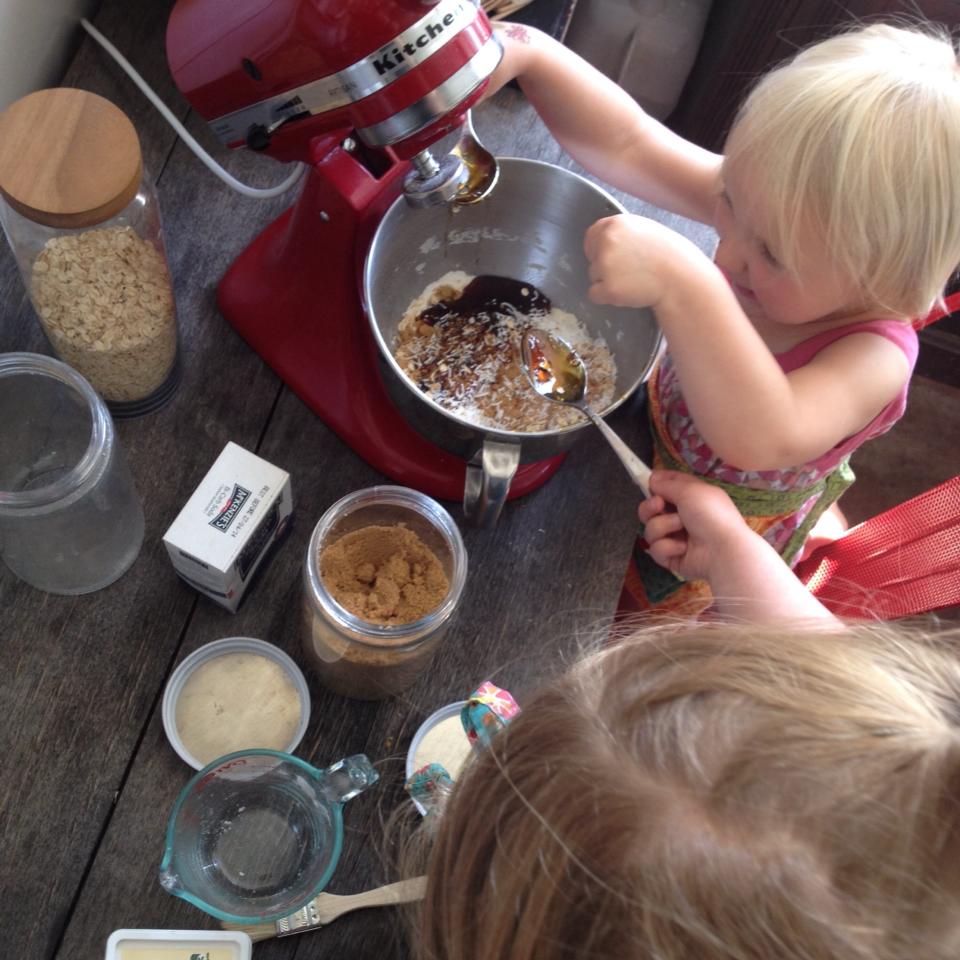
Measuring the ingredients for Anzacs from Australia.

Measuring the ingredients for “A: Anzacs from Australia.” Also a great opportunity to talk about the amount of sugar in sweets like this.

It comes as no surprise that cooking is a wonderful educational tool in itself: It is tactile (pouring, stirring, needing), sensory (taste, smell, sight), draws heavily on numeracy skills (weighing, counting, timing), scientific reactions (dissolving, heating, cooling), and literacy (from recognising the simple word ‘cup’ when measuring, right through to being able to read recipes independently) … Plus you get the satisfaction of creating something that you can eat at the end. This is probably the benefit my own 3 and 5 year olds enjoy most!

When we embarked on our culinary adventure around the world, we didn’t buy a plane ticket – instead we looked at what was in our own cupboard. From making Vietnamese rice paper rolls in the park, to investigating the origins of the pancake. Each county we ‘visited’ on our cooking journey we added a little geography, and a lot of discussion, and play surrounding that county. As a result both of my children have an expanded world view.

Continue reading

BIG HISTORY FOR LITTLE PEOPLE

The stories we tell about our being (both public and private) are a cornerstone to our developing sense of identity – for an individual child, and indeed for the community as a whole.

After watching a presentation by David Christian (a key mover and shaker in the Big History movement) I am further inspired to incorporate ideas of ‘Big History’ (that is; history understood form a big picture perspective) into play based learning for early childhood.

My own daughter, Elka 3yo, insists that everything before now is ‘last year’ (yes; yesterday is a very long time ago when you are 3!) So with this daily reminder I fully understand the realities of a developing mind struggling to grasp the concept of time passing. Research shows that neurological pathways in Elkas young brain are forming to understand the complex idea of time, but the extensive process of developing that understanding will only be fully accomplished with the experience of time passing.

With this unquestionable evidence noted, even 3yo Elka can tell you (with some genuine understanding) that ‘dinosaurs lived a long time ago, and they’re not alive any more’. This is a concept that has been built upon by the numerous references to dinosaurs around her (from dress ups, toys, and stickers, to book and even all out dinosaur birthday parties). While history is usually reserved for older students, it is not such a giant leap to conclude that other milestones in our ‘big history’ could equally be as engaging subjects for play based learning in these early years!

From imagining the world of ancient civilisations to looking at how our landscape was formed (volcanic eruptions and a century of erosion is as simple as sand play with some added baking soda and vinegar!)

While I am yet to experiment on my darling offspring, I believe that her being able to understand a vague order of chronology (ie dinosaurs before kingdoms, pyramids before Nan and Pop etc) is well with in her abilities and would be aided by a general time line in her environment that we can refer to when we make new discoveries.

This sense of belonging (and owning a place in time as well as physical space) is something that will enhance all aspects of the growth: from empathy and understanding, to exploration and a desire to invent the next thing to change the course of history.

Now, on the topic of history: the Yoyo is believed to be the second oldest toy in human history. (Without google) do you know what the oldest is? (Note your answers in the comments below, future post will show how we made the oldest toy in history.)