EASY ACTIVITIES TO BUILD YOUNG BRAINS: BUILD OUR SOLAR SYSTEM

There are many wonderful ways to represent the solar system but we chose a simple one that will stay with us as a reference point for the rest of the year.

Unless you are a keen stargazer you may want to refresh a few interesting points about the planets before you start. This is a good place to start.

IMG_3036

With research book (or iPad) in hand tell your kids the most interesting things you know about the first planet from the sun. Ask them how best to represent these qualities in their planet and get those paints mixing!
IMG_3039

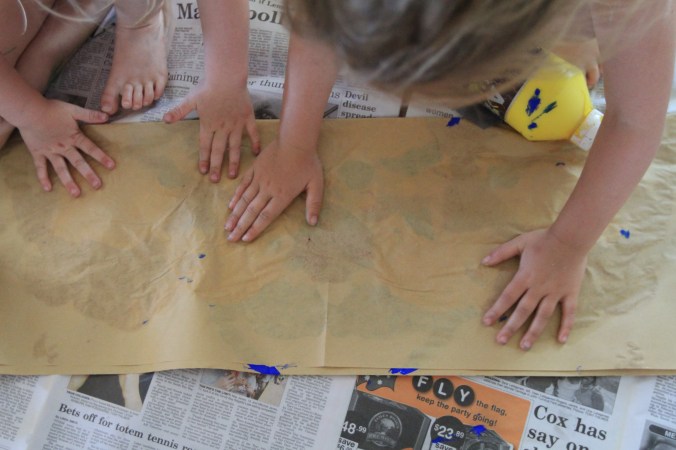
Repeat this process for each of the planets as you work your way out from the sun. To re-enforce the idea of colour mixing I encouraged the kids to choose at least 2 colours for each planet. (The delight of kids learning red and yellow forms orange never grows old!)

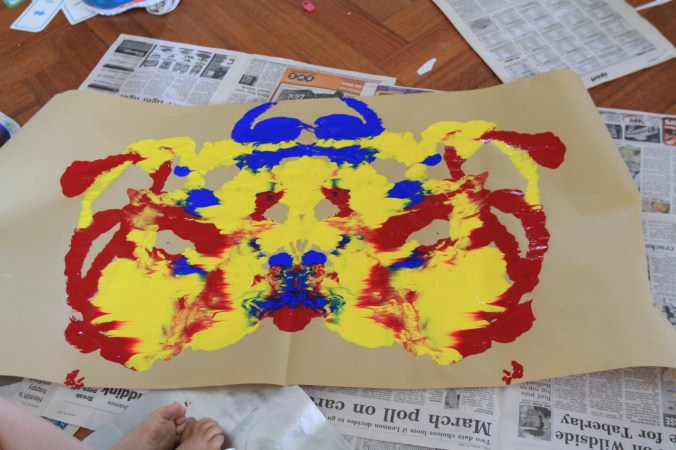
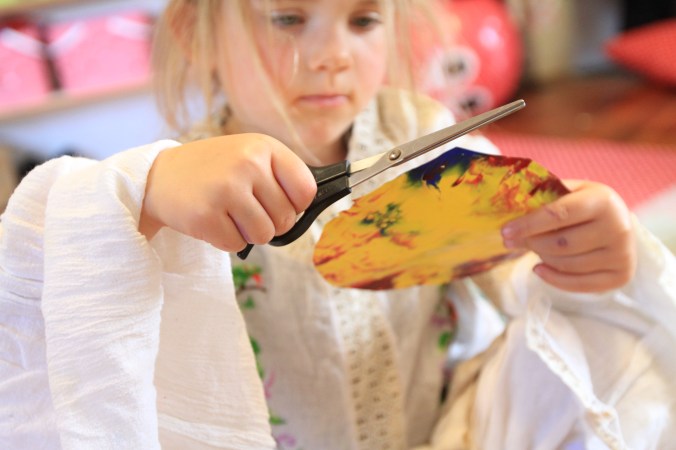
Depending on your kids you may like to mix up your paining technique to ensure each planet is a unique; we started with brushes, moved onto squish painting (where you put dobs of paint, fold the paper and squish to see what happens) and then ended up making hand prints to decorate the last of our planets.
IMG_3027

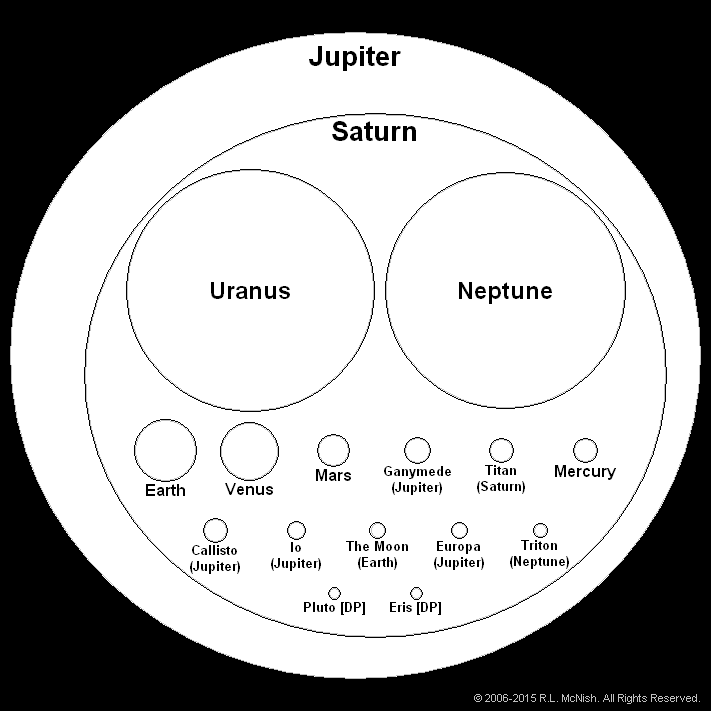
Once all are dry, cut your planets to scale. I referred to this site, with the diagram below, to get approximate scale, though found that accurate scale was not necessarily practical (I didn’t want to smallest to be the size of a pin head, nor did I want the largest to be the size of an umbrella – we compromised and made them all a little closer in size for practical reasons!)
These planets now decorate our upper walls and we have a small paper rocket (left over from our straw spaceship adventure) that visits a different planet each day, finding facts and reminding us that we are just a tiny part of this huge universe!
IMG_3371

EASY ACTIVITIES TO BUILD YOUNG BRAINS: SPARKLE WRITING.

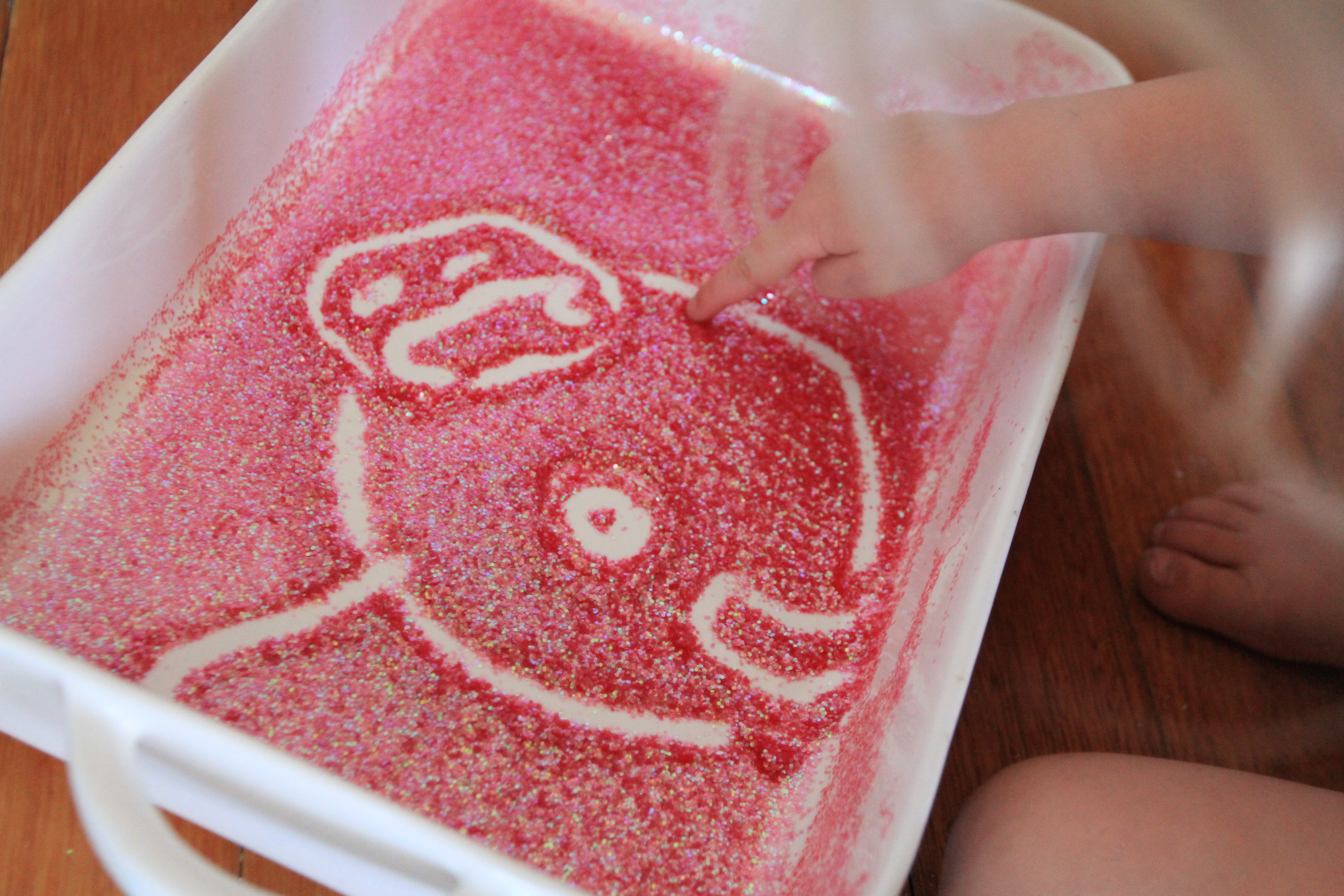
IMG_2981

Sand writing is a lovely tactile way to learn letter shapes… but sparkle writing is something that is hard not to be excited about starting!

Simply fill a container with glitter (not too thick, you only need a couple of mm deep for the letters to form).

When they want a fresh surface to write on simply shake the container slightly and it will clear the way for more creations.

The 5yo wanted to write words, the 3yo was happy making letters and shapes (all these activities can be supported by showing an example for them to model their own work on)… but by far the most fun was had when the 3yo returned to play on her own; she was consumed for quite some time drawing little pictures by herself. It served not only as a shape recognition and letter forming practice, but also as a quite, meditative time for the kids throughout their day. Quite reflective time (forgive the pun) is essential for processing information, particularly for those with more introvert tendencies, and is as important to learning as the abundance of information and stimulation that we must also provide to their developing minds.

IMG_3023

House tip: We welcome glitter in our world, but I know many sensible people who avoid it because of the excessive cleaning up required after the fact. To my surprise this unmonitored glitter quite area did not spread (like other glitter art experiences do!) and even more astounding was that it lasted an entire week without mess. I believe the heavy container that we put the glitter in helped with this, and because it was seen as something special the kids were happy playing with the magic dust in their own time, and without spreading it!

THINGS TO SEE AND DO: BUILD A GIANT SAND SCULPTURE.

DSCN5918

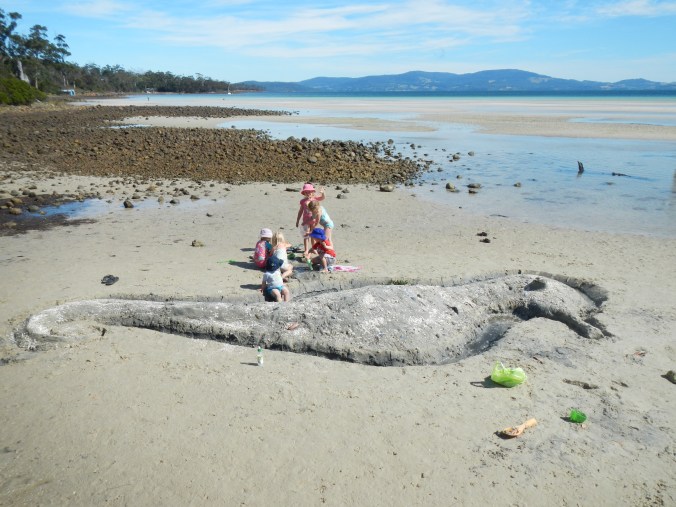
Summers Bay, sunshine, splashing in the shallows, schools of small fish swimming past our feet, soldier crabs in the sand, and even the guest appearance of a stingray swimming slightly out of reach. We were delighted by the spontaneous S learning that we found at our trip to Sommers Bay (Tasman Peninsula, Tasmania). And while we’re told this is not unusual for this location it’s not something you can usually plan for in an outing. (As much as you’d like to, wildlife just doesn’t run to a predictable booking schedule!)

Sand sculptures on the other hand are something you can create at any beach (or large sand play area). Bring a bucket, spade and an (adult sized) shovel to get digging! The kids (and you!) will be amazed at what you can create in a beach trip.

DSCN5827

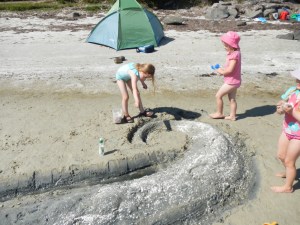
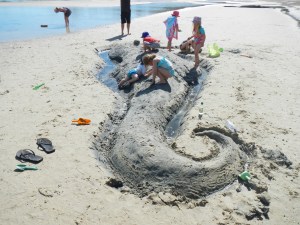
First up we chose a location, and the kids told me what to draw as I followed their collective instructions mapping out a big tummy, curly tail, long nose and head on the sand. We then all got our little spades and started to dig a big trench around the shape (piling the sand in the middle of the picture, as you would when making a mote around a sand castle.) Gradually the children tired of digging and got a bit distracted safely splashing in the shallows near us, and generally had a good time in the water. As us adults continued digging (and sharing the few facts we had learnt about seahorses!) the children came back and joined us. By the time we were ready to pat down and sculpt the shape, all the children were involved again. The giant 4m seahorse came together remarkably fast, and then much time was spent as the children decorated it with shells.

DSCN5886

The older children planned and placed and organised themselves on a mission to complete the seahorse (very important work, this seahorse building!) while the younger delighted in sticking shells in the sand.

DSCN5905

Sand play is always a winner for many reasons. It’s the elemental stages of physics, it’s tactile, it’s physical… and when done in a team like this the social development, planning, and problem solving involved is spectacular.

DSCN5895

Plus it’s satisfying. Go build a giant seahorse that will be washed away at the next tide. It’s brilliant.

BIG HISTORY FOR LITTLE PEOPLE

The stories we tell about our being (both public and private) are a cornerstone to our developing sense of identity – for an individual child, and indeed for the community as a whole.

After watching a presentation by David Christian (a key mover and shaker in the Big History movement) I am further inspired to incorporate ideas of ‘Big History’ (that is; history understood form a big picture perspective) into play based learning for early childhood.

My own daughter, Elka 3yo, insists that everything before now is ‘last year’ (yes; yesterday is a very long time ago when you are 3!) So with this daily reminder I fully understand the realities of a developing mind struggling to grasp the concept of time passing. Research shows that neurological pathways in Elkas young brain are forming to understand the complex idea of time, but the extensive process of developing that understanding will only be fully accomplished with the experience of time passing.

With this unquestionable evidence noted, even 3yo Elka can tell you (with some genuine understanding) that ‘dinosaurs lived a long time ago, and they’re not alive any more’. This is a concept that has been built upon by the numerous references to dinosaurs around her (from dress ups, toys, and stickers, to book and even all out dinosaur birthday parties). While history is usually reserved for older students, it is not such a giant leap to conclude that other milestones in our ‘big history’ could equally be as engaging subjects for play based learning in these early years!

From imagining the world of ancient civilisations to looking at how our landscape was formed (volcanic eruptions and a century of erosion is as simple as sand play with some added baking soda and vinegar!)

While I am yet to experiment on my darling offspring, I believe that her being able to understand a vague order of chronology (ie dinosaurs before kingdoms, pyramids before Nan and Pop etc) is well with in her abilities and would be aided by a general time line in her environment that we can refer to when we make new discoveries.

This sense of belonging (and owning a place in time as well as physical space) is something that will enhance all aspects of the growth: from empathy and understanding, to exploration and a desire to invent the next thing to change the course of history.

Now, on the topic of history: the Yoyo is believed to be the second oldest toy in human history. (Without google) do you know what the oldest is? (Note your answers in the comments below, future post will show how we made the oldest toy in history.)